Showing posts with label tohoku university. Show all posts

Guten tag aus Deutschland!
Although I am in Germany, this time I would like to write about another thing, that is my experience in collaborating with another laboratory in Tohoku University.

Since April 2016, I am enrolled as a student of the Inter-Graduate School Doctoral Degree Program on Science for Global Safety (G-Safety), Leading Graduate School Program. This program requires me and the other enrolled students to perform a project with the other laboratory, which is called Convergence Laboratory Training (C-Lab). The project can also actually be found in Mechanical Engineering division under the title of Frontier of Mechanical Engineering (機械工学フロンティア). In this project, I actually joined 2 programs, but I will report only one here, with relation to our laboratory.

I joined a project with Miura Laboratory’s students. We started the project in May 2016 by discussing about what we will do. Compared to Miura Lab, our laboratory is very strong in sample fabrication, because to make a single MEMS (or even to demonstrate a single packaging technology), we need to undergo a long fabrication process, which consists of various processes. And often we found some failure in our process which makes us have to redo the processes. This trial and error process taught us how the real micro-fabrication process is.

On the other hand, compared to our lab, Miura Lab is very strong in the evaluation technology for materials. Their typical research is to deposit a material using a specific technology, and evaluate various properties in correspondence with different deposition parameters. Every student in Miura Lab masters an evaluation technology deeply.

We finally decided to study the property of electroplated gold (Au), since gold has never been studied in Miura Lab, and used it as a material for MEMS packaging in my research. Then we evaluate it using the specialties of each 4 Miura Lab’s student.

This was a good collaboration since I have no any basic about the evaluation technology for thin-film properties before (which they are very strong). And they didn’t know anything about Au electroplating. So all of us learn a lot from this project.

So after doing Au electroplating and apply some annealing variation, we evaluated the film using nano-indentation test, electron backscatter diffraction (EBSD) and micro-tensile test. I learned from the basics of these evaluation methods and see the real experiments. I performed the real experiments only for the EBSD.

Nano-indentation test and EBSD are conventional technologies, which is actually used by almost all materials researcher. Nano-indentation test is used to measure the Young’s modulus and hardness of a thin film and EBSD is used to evaluate the crystal orientation and size on a surface of a material. However, the micro-tensile test is a novel technology. It is used to evaluate the strength of grain or grain boundary. In my opinion, although the principle does not looks so complicated, the fabrication of the test sample is very difficult. Everything is put inside a focused ion beam (FIB) machine and patterned using ion beams. Quite unbelievable. Even the test itself is done inside the FIB machine and takes around 1 full day for 1 sample making until the test (all inside the same FIB machine), regardless it is successful or not.

Finally I used some of the knowledge obtained from this training for my research. That is using EBSD to analyze the grain boundary of the surface resulted by the fly-cutting process, and presented the result in an international workshop.

The international workshop is titled the 2nd USTB-TU Joint Workshop on Advanced Materials and Manufacture, held at the University of Science and Technology Beijing (USTB), China, on 21-24 February 2017. It is a joint workshop by the Fracture and Reliability Research Institute of Tohoku University and the Collaborative Innovation Center of Steel Technology of the USTB. The workshop is done for both fostering the collaboration between 2 institutes, as well as to give students an opportunity to practice giving presentation in an international environment. Each student was given a slot for oral presentation as well as poster session. Maybe it is also good to have such kind of joint workshop in our lab for practice. In this workshop, I was surprised that the students from Miura Lab are B4 students. They have been given such good opportunity from a very young age.

For me, it was a practice in giving presentation to people from different background and research interest. As you may guess from the title of the workshop, the main interest of the people there is the materials and manufacturing technologies. I think there were only a few people in the workshop who has ever heard about the term “MEMS” before. So I need to somehow modify my talk. And I also learned a lot about evaluation technologies for material properties.

Here I would like to share some photos:
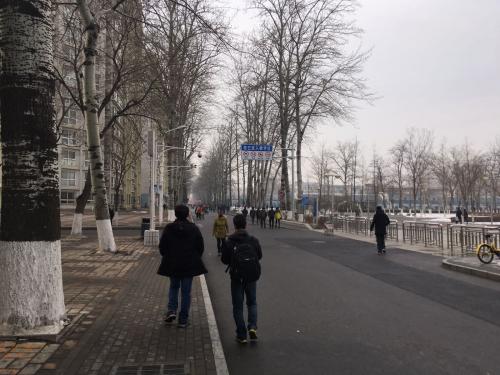

A typical road on a typical day in Beijing. The sky in Beijing is not blue due to the high amount of pollution mainly from industries and transportation. Let us protect our environment!
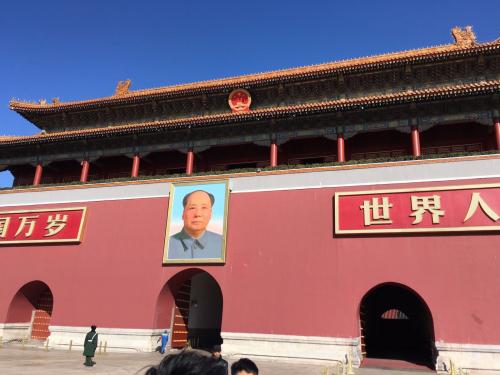

But fortunately the sky was blue during the day for excursion! As one of the destination, we visited the Palace Museum. Chinese students must know who this guy in the photo is!
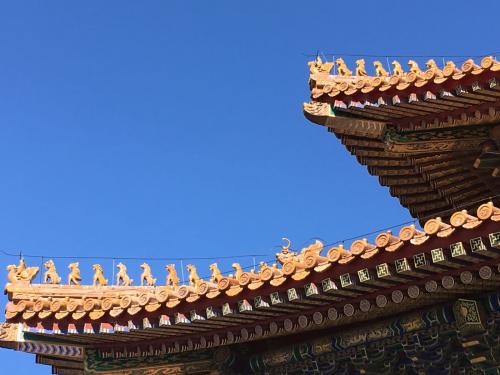
The roof of the temple is very artistic!

Before ending this post, I would like to thank the G-Safety program, which made this collaboration possible. I would also acknowledge Tanaka-sensei and Hirano-sensei for their guidance in my research. Also thanks to Kaneko-san for introducing me to this G-Safety program. Then the last but not the least, I would like to thank Miura-sensei and his lab members who have provided me the opportunity to learn something new.

And finally I would like to close this post with a quote:
For young researchers, don’t be too focused on your field. You should read other field’s literature, hear and discuss with other field’s researchers. Maybe the idea will come from other fields.
- Prof. Jean-Pierre Sauvage
(Nobel Laureate in Chemistry 2016)
at the Nobel Prize Dialogue Tokyo 2017: The Future of Intelligence

Dear Tanaka Lab’s student blog reader,

After thesis and defense season, graduation season is coming for final year students. However, for undergrads 2nd year, this season might be different, yet very important, since they have to choose their laboratories. Here we will give a short introduction of how do we do research in Tanaka Shuji Lab, of course, from students' point of view!

General research topic in Tanaka Shuji Lab is about "MEMS".


MEMS (micro electro mechanical systems) is a very small device that is driven by electricity. Examples of MEMS in our daily life are acceleration sensors in smartphones and game consoles, or also microphones in smartphones. MEMS integrates the aspects of mechanical, electrical, optical, thermal, materials, and others, to finally be fabricated by microfabrication technology that is used for semiconductors. Nowadays, MEMS is used in wide applications, such as for automobiles, communications, robotics, biotechnology, medical welfare, infrastructure maintenance, and energy. Even in the hottest topics these days, the so called Internet of Things (IoT), MEMS technology is used to obtain various data for further development of artificial inteligence and deep learning process. Here in Tanaka Shuji Lab, we are prototyping various kind of MEMS, designing state-of-the-art, developing fabrication technologies, new materials, and even making MEMS in the system level that is ready for real application.

According to Tanaka-sensei, here is our research:
http://www.mems.mech.tohoku.ac.jp/research/index_e.html

Because we are doing various researches on MEMS, almost every student are doing totally different things. Even students in the same year, they may have totally different research themes. To accomodate everyone's research, research groups are established in Tanaka Shuji Lab for members whose research themes are closely related. After joining Tanaka Shuji Lab, everyone will belong to any of these groups.

As of FY2015, we are divided into 6 groups in Tanaka Shuji Lab, as follows.

1. Tactile Sensor and System Integration Group
Leader: Assoc. Prof. Masanori Muroyama

2. Packaging, Installation, and Process Group
Leader: Assist. Prof. Hideki Hirano

3. Piezoelectric Material & Device Group
Leader: Assoc. Prof. Shinya Yoshida

4. Accoustic Device Group
Leader: Prof. Michio Kadota

5. Themal, Optical and Bio-device Group
Leader: Assist. Prof. Takashiro Tsukamoto

6. Fraunhofer ENAS Project Center Group
Leader: Assoc. Prof. Joerg Froemel

Basically, we are doing research under supervision of each group leader in daily basis. If something happen in our research, or if we find something interesting, we usually discuss it with the group leader first.

So, does it mean that if we belong to one group we will not know what the other's doing in the other group?

The answer is

.
.
.
.
.


No! Why?

Reason no. 1: Soudankai & Danwakai

In Tanaka Shuji Lab, we have 2 frequent progress report meetings. One is called soudankai, that is basically means consultation, and another one is called danwakai, that basically means seminar. Soudankai is held twice per month for every group, three groups at the same day with some groups are joined. In soudankai, we usually report what we have done in the past 2 weeks, what have we achieved, what problems have we faced, and what are we planning to do in the next 2 weeks. In soudankai, all group leaders and Tanaka-sensei is also there, so we may have some insightful ideas and advice from them.

Danwakai is a bit different than soudankai. Everyone have their turn for presentation around 3-4 times every year, and the presentation is done in front of all lab members. In danwakai, we hold an international conference style presentation with a student as a moderator, which is limited 40 minutes presentation session without any disturbance, and followed by 20 minutes Q&A session. But well, some people deviated from this rule. The presentations are done fully in english, and the materials should be uploaded to the server beforehand, so we have to carefully prepare ourselves. Here, questions may also come from lab members that belong to the other group. This danwakai might be a good training for students to make presentation in a good manner that is easily understandable.

Reason no. 2: Custom of teaching each others

In fabricating a MEMS device, we are using various kinds of processes and machines. To fabricate a good MEMS which process is better, which material is suitable, which machine should we use are of the challenges. And to find the answer, there is no way other than asking people that are more experienced, even people from the other group. Moreover, in MEMS fabrication, we are basically using many different machines, and we have to learn how to operate each machine from each responsible person (student or staff).

Reason no. 3: Open environment

Tanaka Shuji Lab is located in Kyodo-to (Research Bld. M.A.E / A15 on the map) room 113. All students, staffs, and professors are staying in the same room, so it is easier for discussions, even to discuss things that are not related to research. Moreover, Tanaka-sensei's room is also normally opened, so we can enter at anytime if we have something to discuss.


If we have some results, we are also able to go for conferences, and even to write journal papers. Tanaka-sensei said, "Research is to be published in conferences and journal papers!" Experience in giving presentations and writing papers will be very valuable for students. Moreover, by going to conferences we are also able to make discussions with many experts. In Tanaka Shuji Lab, this opportunity is opened for everyone.

Some students wrote their conference experience here:
http://biodevice.blog.fc2.com/blog-category-1.html

Schedule in Tanaka Shuji Lab is 1 year research for bachelors, 2 years research for masters, and 3 years research for doctors. Bachelors deliver their defense in February, and submit their thesis in March for graduation. Masters do their pre-defense in December, make first thesis submission in January, then final defense and final thesis submission in February for graduation. We have to plan our experiments carefully to finish it in time, and not to be hurry near the deadlines. There are also some students who are continuing their research to the next level, i.e. bachelor research to master, or master to doctor.

There is some words from Tanaka-sensei that he usually delivers in the opening lecture for lab members.

"The key points of research process are detailed planning, bold execution and logical consideration. These are important for not only research but also other works.
Another important thing is to get the self-confidence that you completed the research process. In Japanese universities, there are few chances that students experience heavy intellectual or physical loads, if they do not perform research work satisfactorily. The students who did not study hard cannot stand the load of competitive works after graduation. I wish students to acquire both physical and intellectual strength."

Dear Tanaka Lab’s student blog reader, this is Salman, a B4 student.

TOKYO (12/16), The SEMICON Japan 2015 was held in Tokyo Big Sight on 16-18 December 2015. From Tanaka Lab, besides having our own booth which is managed by staffs, five students – Kaneko-san (M2), Suzuki-san (M1), Sato-san (M1), Zhu-san (M1), and me – also attended this event for one day.

Tokyo Big Sight

We arrived at the venue around 10 minutes before its opening, and there were already so many people waiting and doing registration on the reception site. We have already registered beforehand, so we can directly enter the site at the opening.

SEMICON Japan 2015

It was my first experience in attending such industrial fair. It really amazed me, how they can gather many high-level industries, and even research laboratories from university. Those industries and laboratories provided demonstration of their technology, to attract each other for collaboration. Besides that, there was also a job hunting corner for those who are interested. I was quite surprised that some social sciences students also attended the job hunting corner in such science-atmospheric event. This has broadened my mind that we need to collaborate with each other to achieve higher achievement.

Some industries we saw were not unfamiliar for us. DISCO, ULVAC, and Swagelok are of the industries that are familiar to us, since we are dealing with their products also in Tanaka Lab. However, there are also many industries which are unfamiliar for us, and it was interesting to see their technologies, which we have never seen before. One of them was Minimal Fab, which impressed us with their clean room-replacement technology, within many fancy-looks small machines. Moreover, to attract people, Fujikin also arranged a race in making an assembly, the fastest five during the event will receive some prize, which made the event become livelier.

In this event, not only semiconductor technology was presented. Many real things were also presented. For instance, Tesla Motors exhibited their latest electric car which has a very fancy design and offers highly efficient space usage. However, I am still wondering if such electric car is really better than the gasoline-based car which is widely used up to now. Including the car automation which is becoming an interesting topic, is it really that good? We really have to think carefully of the technology before developing it.

Tesla's electric car

We also passed by Tanaka Lab’s booth in the “World of IOT” corner, which was managed by Takoshima-san, and MEMS Park Consortium’s booth in “Tohoku Pavilion” corner, which was managed by Totsu-sensei. Tanaka Lab's booth was placed next to MEMS Park Consortium's booth which was managed by Fukushima Prefectural Koriyama-kita Technical High School that demonstrated their robot which is one of the winner on iCAN 2014.

Tanaka Lab's booth

Thanks to Sato-san for providing the photos. And finally, we would like to thank our sponsor, SEMICON Mirai-College, who has provided us return travel expenses from Sendai to Tokyo.

Tanaka Lab's booth Tanaka Lab's booth

Suzuki-san seems to enjoy this event very much.

Biomedical Applications :''

 (وَعَسَى أَن تَكْرَهُواْ شَيْئاً وَهُوَ خَيْرٌ لَّكُمْ وَعَسَى أَن تُحِبُّواْ شَيْئاً وَهُوَ شَرٌّ لَّكُمْ وَاللّهُ يَعْلَمُ وَأَنتُمْ لاَ تَعْلَمُونَ (البقرة: 216

"... Boleh jadi kamu membenci sesuatu, padahal ia amat baik bagimu, dan boleh jadi (pula) kamu menyukai sesuatu, padahal ia amat buruk bagimu; Allah mengetahui, sedang kamu tidak mengetahui." (Al-Baqarah: 216) 

Sebelumnya gak terbayang sih akan ambil major ini. Lha waktu SMA aja pernah (hampir) semua tes blok dalam 1 semester untuk mata pelajaran biologi gak lulus KKM. Alhamdulillah waktu itu terselamatkan salah satu sub-tes blok yang diatas KKM, meskipun UAS-nya juga tipis (gak lolos KKM juga) tapi nilai akhirnya masih lolos. Saking gak senangnya dengan biologi, ketika memilih jurusan kuliah-pun saya memilih jurusan-jurusan yang jauh dari bau-bau biologi.

Department of Bioengineering and Robotics, Tohoku University
Ketika kuliah tingkat awal, saya masih mikir-mikir untuk ambil mata kuliah dasar biologi, meskipun akhirnya diambil juga dan ngos-ngosan. Saat masa awal ini juga saya mulai tertarik dengan MEMS (Micro-Electro-Mechanical System). Tohoku University ini juga ternyata termasuk salah satu yang riset MEMS-nya terdepan.

Masuk tingkat 2, saya mulai lirik-lirik lab MEMS, yang ternyata aplikasinya sangat luas. Mulai dari sistem di kendaraan, optik, elektronik, pertanian, dan sampai kesehatan. MEMS ini ternyata adalah suatu sistem-terdiri atas sensor dan aktuator-berukuran sangat kecil dan berkemampuan dahsyat.

Masuk tingkat 3, saya sudah harus memilih lab dan penjurusan yang sebenarnya. Di Mechanical Engineering Tohoku University, mahasiswa tahun ketiga akan masuk 'penjurusan' yang sebenarnya. Ada 6 pilihan jurusan:
  1. Mechanical Systems and Design
  2. Nanomechanics
  3. Aerospace Engineering
  4. Environmental and Energy Engineering
  5. Quantum Science and Energy Engineering
  6. Bioengineering and Robotics
dan lab MEMS tersebar di setidaknya 3 diantaranya. Di Mechanical Systems and Design ada satu lab MEMS untuk sensor berbasis cantilever beam. Di Nanomechanics ada beberapa lab MEMS untuk optik, elektronik, dan energy harvester. Dan di Bioengineering and Robotics ada beberapa lab MEMS untuk aplikasi kedokteran dan pertanian.

Tactile Sensor Network Array, salah satu produk terbaru S. Tanaka Lab.
Dan sekarang disinilah saya, di S. Tanaka Lab, Advanced Bio-Nano Devices, Department of Bioengineering and Robotics.

Mungkin dulu saya setengah mati tidak senang dengan mata pelajaran biologi, tapi siapa yang tahu sekarang. Belakangan saya sadari, ternyata memang teknologi itu dikembangkan dengan memodelkan manusia dan ciptaan-Nya yang lainnya.

Bioengineering

by on 7/05/2014
Biomedical Applications :''  (وَعَسَى أَن تَكْرَهُواْ شَيْئاً وَهُوَ خَيْرٌ لَّكُمْ وَعَسَى أَن تُحِبُّواْ شَيْئاً وَهُوَ شَ...
Datang ketika musim gugur. [foto oleh Fuad]

Bagaimana sih sistem perkuliahan di Jepang? Mungkin tidak banyak yang punya kesempatan untuk menempuh pendidikan dari program sarjana di sini. Dan mungkin juga banyak yang ragu-ragu untuk berangkat berkuliah di Jepang karena belum mengerti sistem perkuliahannya. Insya Allah ane akan tulis beberapa mengenai perkuliahan ane di Tohoku University ini. Secara umum kurikulum perkuliahannya bisa dilihat disini.

Di Jepang ini, pada umumnya tahun ajaran dimulai di bulan April dan selesai di bulan Maret. Begitu juga di Tohoku University. Meskipun begitu, program kami, program internasional sedikit berbeda. Kami mulai menjadi mahasiswa universitas pada Oktober 2012. Dan Tohoku University ini menetapkan sistem bahwa kami masuk di semester ke-2. Jadi pertama kali kami masuk, secara ofisial, langsung semester 2, karena semester pertamanya sudah terlewati (April 2012-September 2012). Dan untuk kami yang berkuliah di School of Engineering, kelulusan normal tetap di semester 8. Jadilah ukuran kuliah normal 7 semester (dari 2-8), atau bisa lebih cepat 1 semester bila memenuhi beberapa persyaratan. Setelah ini ane akan menyebut semester pertama ane berkuliah di Tohokudai ini sebagai semester kedua.

Di semester kedua ini, Oktober 2012 - Maret 2013, ane mengambil kredit sejumlah 33. Jumlah kreditnya memang fantastis, karena kami dituntut untuk mengejar 'ketertinggalan' satu semester di awal tadi. Apalagi jumlah kredit untuk 1 mata kuliah rata-rata hanya 1 atau 2. Di semester kedua ini, semua mahasiswa mempelajari mata kuliah yang sangat dasar, sehingga sistemnya seperti TPB di ITB dimana mahasiswa dari berbagai macam jurusan ada dalam 1 kelas.

Jadwal kuliah semester kedua.
Mata kuliah yang ane ambil sepertinya mata kuliah standar untuk tingkat dasar. Mari kita bahas satu-persatu.

An Introduction to Information Science B (2 kredit), mata kuliah wajib. Bahasa pengantarnya full bahasa Inggris. Materi yang dipelajari adalah dasar-dasar penulisan ilmiah dengan LaTeX, bersama penggambar grafik Gnuplot dan Inkscape di paruh semester pertama. Dan di paruh semester kedua belajar mengenai dasar-dasar bahasa pemrograman C. Karena yang dipelajari hanya dasar, kalau kedepannya ilmunya tidak diprakekkan bisa lupa juga. Alhamdulillah ilmu LaTex dan C ini berguna sekali buat ane bikin laporan sampe sekarang dan belajar programming yang lebih lanjut.

Mineralogy, Petrology, and Geochemistry (2 kredit), mata kuliah pilihan bersama Linear Algebra B, Probability & Statistics, Physics C, Chemistry A, Chemistry C, dan Biology A (ambil minimal 8 kredit). Bahasa pengantarnya full bahasa Inggris. Materi yang dipelajari adalah sekedar pengenalan materials sciences macam struktur atom berbagai jenis material dan yang menentukannya. Sensei-nya lebih banyak memberi paper-paper yang doi tulis sendiri untuk kami baca. Alhamdulillah lumayan bermanfaat sampai sekarang setidaknya ketika masuk kelas materials sciences ane sudah mengenal dasarnya sedikit.

Life and Nature (2 kredit), sebenarnya mata kuliah pilihan, tapi matkul pilihan yang satunya gak bisa diambil, jadilah harus ambil matkul ini. Bahasa pengantar full bahasa Inggris. Yang dipelajari adalah mengenai ekosistem. Alhamdulillah ilmu ini menyadarkan ane bahwa engineer pun harus sadar akan ekosistem dan tidak membuat sistem yang aneh-aneh sehingga mengganggu ekosistem.

Basic Japanese 1 (4 kredit), mata kuliah wajib. Belajar bahasa Jepang dari 0 di kelas ini. Luar biasa sekali senseinya macam guru TK mengajarnya, ane tidak pernah bisa tidur di kelas ini. Alhamdulillah pengetahuan ini SUPER berguna buat survive di Jepang ini karena orang Jepang kebanyakan gak bisa bahasa Inggris. Kelas ini bisa di-skip bila punya hasil tes JLPT minimal N3.

Biology A (2 kredit), mata kuliah pilihan, tapi sudah kepalang basah ambil. Bahasa pengantar full bahasa Inggris. Yang dipelajari adalah biokimia, mengenai mekanisme yang terjadi dalam sel. Bagi ane sudah cukup mendetail yang dipelajari di mata kuliah ini. Alhamdulillah ternyata mata kuliah ini bermanfaat bagi saya, karena sekarang saya terjerumus ke Bioengineering.

Linear Algebra A (2 kredit), mata kuliah wajib. Bahasa pengantarnya full bahasa Inggris. Yang dipelajari adalah dasar-dasar aljabar linear yang sangat dasar, seperti mendalami apa yang sudah kami pelajari semasa SMA. Alhamdulillah bermanfaat sekali matkul ini dalam memberi penjelasan berbagai materi yang akan dipelajari di tingkat-tingkat selanjutnya.

History and Human Society (2 kredit), mata kuliah pilihan, tapi karena kami sudah melewatkan semester pertama, jadilah dari pilihan tersebut tinggal ini yang tersisa. Bahasa pengantar full bahasa Inggris. Mata kuliah ini kadang menarik dan kadang bisa jadi tempat yang tepat buat tidur. Yang dibahas adalah mengenai sejarah kota Sendai dan Tohoku University. Alhamdulillah banyak pengetahuan tentang Tohoku University, yang setidaknya membuat saya bisa menjelaskan bila ada yang bertanya tentang Tohoku University. Juga ada beberapa tour ke beberapa tempat di kampus, yang mungkin jika kami tidak ambil kelas ini tidak akan pernah kesana sampai lulus pun.

Chemistry A (2 kredit), mata kuliah pilihan. Bahasa pengantarnya full bahasa Inggris. Yang dipelajari adalah dasar-dasar mekanika kuantum. Alhamdulillah bisa buat modal buat mempelajari banyak mekanisme kuantum lainnya di tingkat-tingkat lanjutnya.

Economics (2 kredit), mata kuliah pilihan, ada Game Theory atau Management, ane ambil game theory karena terdengar lebih logis dan ane tidak terlalu senang untuk banyak berbicara. Bahasa pengantar full bahasa Inggris. Yang dipelajari adalah game theory untung dan rugi. Alhamdulillah lumayan bisa diterapkan ketika mengambil pilihan.

Exercise in Mathematis and Physics I (1 kredit), mata kuliah wajib. Bahasa pengantar full bahasa Inggris. Di kelas ini dibahas SEMUA teori matematika dan fisika secara singkat dan diberi banyak latihan soal setiap pekannya. Matkul ini inti dari kuliah ane semester kedua ini sepertinya, paling banyak menghabiskan waktu untuk menyelesaikan tugas-tugasnya. Penjelasannya sangat singkat tapi tugasnya advanced, jauh diatas bahkan Calculus C. Biasanya kepala terasa panas dingin sehabis keluar dari kelas ini. Alhamdulillah excercise ini bermanfaat sekali untuk masa depan di Mechanical Engineering.

Overview of Mechanical and Aerospace Engineering (2 kredit), mata kuliah wajib. Bahasa pengantar full bahasa Inggris. Di mata kuliah ini beberapa profesor perwakilan dari 6 jurusan di Mechanical Engineering memberi penjelasan tentang jurusannya masing-masing dan labnya masing-masing. Mulai dari jurusan Mechanical System and Design, Nanomechanics, Aerospace Engineering, Bioengineering and Robotics, Quantum Science and Energy Engineering, dan terakhir Environment and Energy Engineering. Alhamdulillah cukup memberi gambaran bahwa di tahun ketiga nanti kami harus memilih laboratorium dan penjurusan.

World of Fine Arts (2 kredit), mata kuliah pilihan, tapi karena kami sudah melewatkan semester pertama, jadilah dari pilihan tersebut tinggal ini yang tersisa. Bahasa pengantar full bahasa Inggris. Yang dipelajari adalah tentang persebaran peradaban buddha dari berbagai peninggalan di dunia. Ada beberapa field trip juga. Alhamdulillah menambah pengetahuan tentang Sendai juga.

Chemistry B (2 kredit), mata kuliah wajib. Bahasa pengantar full bahasa Inggris. Yang dipelajari adalah dasar-dasar termodinamika. Alhamdulillah lumayan buat modal mengarungi mata kuliah tingkat lanjut.

Health (2 kredit), mata kuliah pilihan dengan Introductory Seminar (minimal 2 kredit). Bahasa pengantar full bahasa Inggris. Di kelas ini kami seperti hanya mengobrol mengenai sistem kesehatan di Jepang. Karena kami berasal dari berbagai negara yang berbeda, mengenai cara beradaptasi dengan cuaca Jepang dan sistem penjagaan kesehatan di Jepang. Alhamdulillah dialog yang cukup menarik dan bermanfaat untuk kehidupan.

Calculus A (2 kredit), mata kuliah wajib. Bahasa pengantar full bahasa Inggris. Yang dibahas adalah mengenai dasar-dasar ilmu kalkulus, seperti mengulang pelajaran SMA dengan lebih mendalam. Alhamdulillah kedepannya banyak bermanfaat untuk menjelaskan dan memodelkan berbagai fenomena.

Physics A (2 kredit), mata kuliah wajib. Bahasa pengantarnya full bahasa Inggris. Yang dibahas adalah mekanika analitis, dibahas dengan mendalam. Melatih untuk berfikir analitis bagi yang sebelumnya menganggap fisika hanyalah hapalan rumus. Alhamdulillah kedepannya ilmu dasar ini sangat diperlukan.

Begitulah kurikulum semester kedua ane. Semester kedua ini masih banyak adaptasi karena segala yang ane hadapi di Jepang ini begitu berbeda dengan yang biasa ane hadapi di Indonesia. Mata kuliah yang banyak dan (ketika itu) ane rasa berat, ternyata seiring berjalannya waktu masih banyak yang lebih berat.

Ganbarou!

Semester 2

by on 4/25/2014
Datang ketika musim gugur. [foto oleh Fuad ] Bagaimana sih sistem perkuliahan di Jepang? Mungkin tidak banyak yang punya kesempatan u...